

- Master Movers Inc
What Information to Share When Requesting a Moving Quote
Quick Overview: When requesting a moving quote, provide enough detail for the moving company to understand the size, distance, access conditions, and services involved in the relocation. The more accurately the move is described, the easier it is for the mover to prepare an estimate based on the actual requirements. Important information to share includes:
Important insight: Details outside the home can matter just as much as the number of belongings. A large shipment with easy access may require different planning from a smaller shipment involving several flights of stairs, long carrying distances, or restricted truck parking. Pro tip: Before requesting the quote, walk through every room and storage area, including garages, basements, attics, closets, and outdoor spaces. This makes it less likely that belongings will be accidentally omitted from the information provided to the mover. |
A moving quote is only as useful as the information used to prepare it. Two households may be moving a similar distance but require very different planning because of the number of belongings, property access, furniture size, requested services, or additional stops.
When requesting an estimate, customers should give the moving company a clear picture of both the shipment and the conditions surrounding the move. That means sharing more than the addresses and preferred date. An accurate inventory, stairs or elevators, parking conditions, unusually large items, and service needs can all be relevant. Knowing what information to share when requesting a moving quote helps the mover understand the scope of the relocation before estimating the work involved.
What Basic Move Details Should You Provide First?
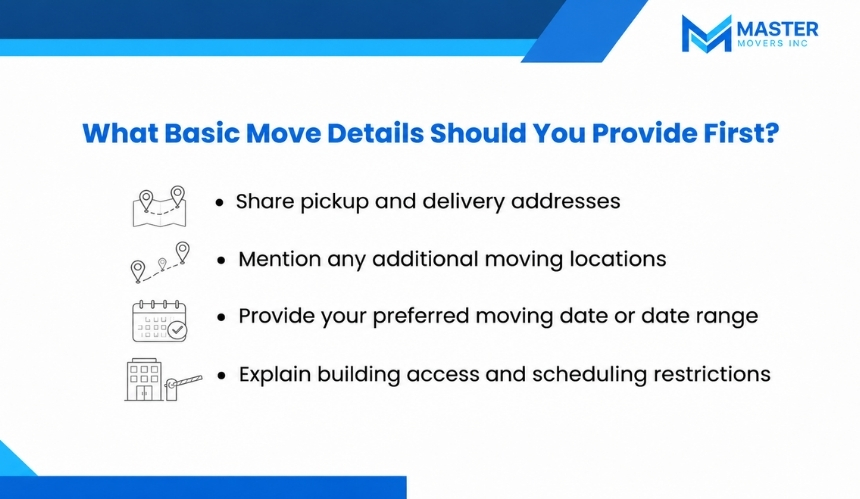
A moving quote should begin with the basic details that define where and when the relocation will take place. Before discussing individual belongings or additional services, customers should provide enough information for the moving company to understand the overall scope of the move.
These details create the foundation for the rest of the quote request and help identify what additional information may be needed.
What Are the Pickup and Delivery Locations?
Provide the pickup and delivery addresses when they are known. If an exact address is not yet available, give the most specific location information possible and explain that the destination is still being finalized.
Customers should also mention whether belongings will be collected from or delivered to more than one location, since an additional stop changes the route and overall moving plan.
What Moving Date or Date Range Are You Considering?
Share the preferred moving date as early as possible. If the date is flexible, provide a realistic range rather than leaving the timing completely open.
The mover should also know about any scheduling restrictions at either property, such as limited building access or reserved moving periods.
Important insight: A quote request should establish the route and timing before moving into detailed inventory questions. If the origin, destination, or expected date later changes, the moving company should be updated so the estimate can be reviewed against the new information.
How Much Are You Planning to Move?
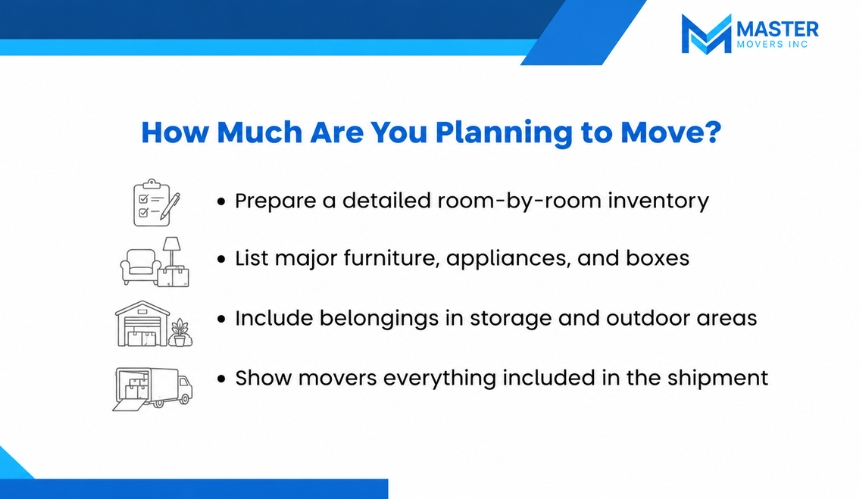
The amount of household goods being moved is one of the most important details to share when requesting a quote. A general statement such as “two-bedroom home” provides some context, but it does not show how much furniture, how many boxes, or how many belongings are actually included.
Customers should describe the shipment as completely as possible so the mover can understand its approximate size and handling requirements.
Should You Provide a Room-by-Room Inventory?
A room-by-room inventory can make the quote request more specific. List major furniture, appliances being moved, approximate box quantities, and other substantial belongings from each area of the home.
If the moving company provides an inventory form or conducts an in-person or virtual survey, customers should point out everything expected to be included in the shipment.
What Items Are Commonly Missed From an Inventory?
Belongings outside the main living areas can easily be overlooked. Customers should check:
- Garages and sheds
- Basements and attics
- Closets and storage rooms
- Balconies and patios
- Under-bed storage
- Outdoor furniture
- Separate storage units
Did You Know?
For interstate U.S. moves, the Federal Motor Carrier Safety Administration advises customers to show the estimator everything they plan to move. Items added after the estimate may affect the final charges or require the estimate to be revised.
Important insight: Inventory accuracy is more useful than simply stating the number of rooms. Two homes with the same number of bedrooms can contain substantially different amounts of furniture, boxes, and stored belongings.
Which Large or Unusual Items Should You Mention?
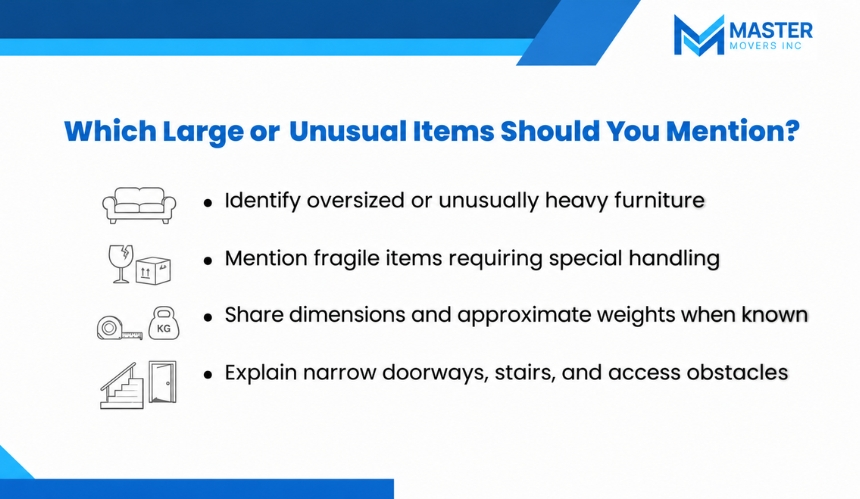
When requesting a moving quote, customers should identify belongings that may require different handling, additional space, or more planning than standard household boxes and furniture. These items should be disclosed during the quote process rather than first pointed out when the moving crew arrives.
Examples may include oversized furniture, particularly heavy pieces, large mirrors, delicate artwork, exercise equipment, unusually shaped belongings, or furniture that may be difficult to move through the available access points.
Why Should These Items Be Disclosed Before the Quote?
Large or unusual belongings can affect the labor, equipment, space, preparation, or handling requirements associated with a move. Providing dimensions, approximate weight when known, and information about where the item is located can give the mover a clearer picture of what will be involved.
Customers should also mention obstacles between the item and the truck, such as narrow stairways, tight corners, or limited doorway clearance.
Pro tip: Photos and measurements can be useful when describing an unusually large item. Showing both the item and its surrounding access area can communicate details that may be difficult to explain through a basic inventory list.
Important insight: Simply listing “large cabinet” or “heavy table” may not provide enough information. The quote request becomes more useful when the mover understands both the item itself and the conditions involved in getting it out of the property.
What Property Access Details Should You Share?
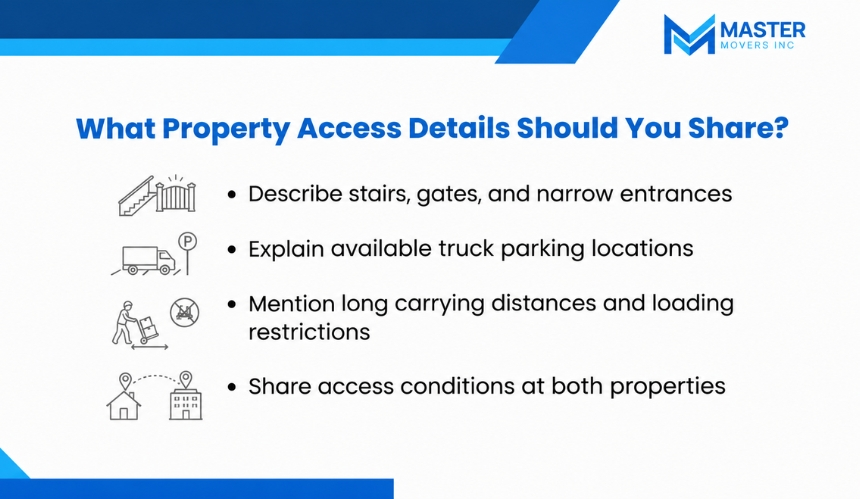
A moving quote should describe more than the belongings being transported. Customers should also explain how movers will reach those belongings at both the pickup and delivery properties. Access conditions can affect the distance items must be carried, the route available to the crew, and the overall requirements of the move.
Mention stairs, narrow hallways, tight doorways, gated entrances, steep driveways, loading restrictions, long carrying routes, or other conditions that could affect movement between the home and truck.
Where Can the Moving Truck Park?
Customers should explain where a moving truck can reasonably access or park near each property. If the truck cannot stop close to the entrance, provide an approximate carrying distance and mention any gates, courtyards, sidewalks, or other areas between the parking location and the home.
Apartment and managed-property moves may also involve designated loading areas, parking permits, or specific building procedures that should be disclosed when requesting the quote.
Did You Know?
Access details can change the amount of time and labor involved even when the inventory stays exactly the same. A shipment carried directly from a ground-floor entrance to a nearby truck presents different moving conditions from the same shipment carried through stairs, elevators, or a distant loading area.
Pro tip: Describe access at both addresses separately. Easy access at the pickup property does not mean the delivery property will have the same conditions.
Should You Mention Stairs and Elevators When Requesting a Quote?
Yes. Customers should tell the moving company about stairs and elevators at both the pickup and delivery properties when requesting a quote. These details help describe the actual route movers will use between the household goods and the moving truck.
For stairs, provide the floor involved, approximate number of flights, and whether the staircase is narrow, steep, curved, or otherwise difficult to navigate. Even a short set of exterior steps should be mentioned if movers must repeatedly carry belongings across it.
What Elevator Information Should You Provide?
For an apartment, condominium, or multi-story building, explain whether the property has a passenger or service elevator and which floor is involved. Customers should also mention whether the elevator must be reserved, whether its use is limited to certain hours, and how far it is from the unit to the loading area.
If building management requires advance scheduling or has specific moving procedures, those requirements should be shared during the quote process rather than after the move has been booked.
Important insight: Saying that a property “has an elevator” may not fully describe the access. The mover may also need to know whether it is available for moving, where it is located, and whether reservations or time restrictions apply.
What Moving Services Do You Need?
When requesting a moving quote, customers should explain which services they expect the moving company to provide. The shipment may be the same, but the work involved can differ depending on whether the request covers loading and transportation only or includes additional assistance.
Customers should identify requested services at the quote stage so the estimate can reflect the intended scope of work rather than leaving service decisions until moving day.
Should Packing Needs Be Included in the Quote Request?
Yes. If packing assistance is needed, customers should explain how much of the household requires packing. This could range from selected fragile belongings to multiple rooms or the entire household.
The quote request should also clarify whether packing materials, unpacking assistance, furniture preparation, or other requested services need to be considered.
Did You Know?
For interstate U.S. moves, federal consumer guidance recommends understanding which services are included in an estimate and which services may result in additional charges.
Important insight: “I need movers” does not fully describe the requested service. Explaining exactly which tasks the moving company is expected to perform helps establish a clearer scope for the quote.
Should You Share Photos or Videos When Getting a Moving Quote?
Photos or videos can provide useful context when a written inventory does not fully show the size of the shipment, the dimensions of furniture, or the access conditions at a property. If the moving company accepts visual information, customers can ask whether it would help when preparing the quote.
Images may be particularly useful for showing unusually large furniture, crowded storage areas, narrow staircases, tight doorways, elevators, or the distance between the property entrance and available truck parking.
What Should Photos or Videos Show?
Visual information should focus on details that help explain the scope of the move. Customers can show major furniture, rooms containing belongings to be moved, storage areas, oversized items, stairs, entrances, and other relevant access conditions.
However, photos should supplement rather than replace an accurate description of the move. Important belongings or access details that are outside the camera view still need to be disclosed.
Pro tip: When photographing an oversized item, include both the item and the route it must travel. A clear image of the surrounding doorway, staircase, or hallway can provide more useful context than a close-up of the furniture alone.
Important insight: Sending photos or completing a virtual walkthrough does not mean later changes can be ignored. If the inventory, services, or property conditions change after the quote request, the moving company should be updated.
Do You Need to Mention Additional Pickup or Delivery Stops?
Yes. Any planned stop beyond the primary pickup and delivery addresses should be included when requesting a moving quote. An additional location changes the route and may also affect the amount of belongings being loaded or unloaded during the move.
For example, customers should mention if the moving crew will need to collect belongings from a storage unit, another residence, or a second agreed location before continuing to the final destination.
What Details Should You Provide About an Additional Stop?
For each stop, provide the location, what will be picked up or dropped off, and any relevant access conditions. Stairs, elevators, restricted parking, gates, loading rules, or long carrying distances should be described just as they would be for the primary properties.
Important insight: An additional stop should not be treated as a minor detail simply because only a few belongings are involved. It changes the planned route and work involved, so it should be disclosed while the quote is being prepared rather than added unexpectedly on moving day.
What Changes Should You Report After Receiving the Quote?
Information provided during the initial quote request may change before moving day. If the size, route, access conditions, or requested services change, customers should inform the moving company rather than assuming the original estimate automatically covers the updated move.
Changes worth reporting include additional furniture, substantially more boxes, a different pickup or delivery address, added stops, newly requested packing services, or access conditions that were not previously disclosed.
Can Added Items Affect a Moving Estimate?
Yes. Adding belongings can change the amount of household goods that need to be handled and transported. A few small boxes may have limited impact, while additional furniture, appliances, storage-area contents, or numerous boxes can materially change the scope originally described.
Customers should provide an updated inventory when significant items are added and ask whether the existing quote needs to be revised.
Did You Know?
For interstate U.S. moves, FMCSA consumer guidance explains that if a customer adds items or requests additional services after an estimate is prepared, the mover may prepare a revised written estimate before loading begins.
Important insight: The information used to request the quote should continue to reflect the actual move. Reporting meaningful changes early gives the moving company an opportunity to review the estimate instead of addressing a different scope of work on moving day.
How Can You Check That Your Moving Quote Request Is Complete?
Before submitting a quote request, review the information from the mover’s perspective. The request should clearly describe what is being moved, where it is going, what access conditions exist, and which services are needed. The goal is to make sure no important part of the move has been left out.
A final quote-request check should confirm:
- Pickup and delivery locations
- Preferred moving date or date range
- Complete household inventory
- Approximate number of boxes
- Large, heavy, fragile, or unusual belongings
- Stairs and floor levels at both properties
- Elevator availability and building restrictions
- Truck parking and carrying distance
- Packing or other requested moving services
- Additional pickup or delivery stops
- Any known access difficulties
What Should You Do if Some Details Are Still Unknown?
Not every detail may be finalized when the first quote is requested. Instead of guessing, customers should identify what is still uncertain and ask whether the mover needs that information before preparing or finalizing the estimate.
For example, if the exact box count, delivery address, or building access arrangement is still being confirmed, say so clearly and provide an update once the information becomes available.
Important insight: A complete quote request does not mean estimating unknown details just to fill every field. Accurate information, clearly identified uncertainties, and timely updates give the moving company a better description of the actual move.
A useful moving quote starts with a complete description of the move. Customers should provide accurate information rather than relying on broad details such as home size or moving distance alone.
- Provide the pickup and delivery locations and expected moving date.
- Describe the amount being moved with an accurate inventory.
- Identify large, heavy, fragile, or unusually difficult items.
- Explain stairs, elevators, parking, carrying distances, and other access conditions.
- Specify which moving and packing services are required.
- Include every planned pickup or delivery stop.
- Clearly identify information that has not yet been finalized.
- Report meaningful inventory, service, address, or access changes after receiving the quote.
When requesting a quote from Master Movers INC, providing detailed information about the shipment, properties, and requested services gives the company a clearer picture of the actual scope of the move.
Important insight: Quote accuracy is a shared information process. The mover needs to ask relevant questions, while the customer needs to provide complete and current details about the relocation.
Frequently Asked Questions
What information do movers need to provide a quote?
Movers typically need the pickup and delivery locations, moving date, household inventory, property access details, and requested services. Customers should also disclose large or unusual belongings, additional stops, stairs, elevators, and other conditions that could affect the scope of the move.
Do movers need a complete inventory for an estimate?
A detailed inventory gives the moving company a clearer understanding of the amount being transported. Customers should include furniture, approximate box quantities, appliances being moved, and belongings stored in garages, basements, attics, closets, sheds, or other storage areas.
Should I mention stairs when requesting a moving quote?
Yes. Provide information about stairs at both the pickup and delivery properties, including the number of flights and any difficult access conditions. Stairs affect the route movers must use and can influence the labor and time involved.
Do I need an exact moving date to request a quote?
An exact date is helpful, but customers who have not finalized their schedule can provide a realistic date range. They should also mention any building restrictions or limited moving hours that could affect when the relocation can take place.
Should I tell movers about heavy or oversized furniture?
Yes. Large, heavy, unusually shaped, or difficult-to-access belongings should be disclosed when requesting the quote. Providing dimensions, photos, approximate weight when known, and relevant access details can help communicate the handling requirements more clearly.
What happens if I add more items after receiving a moving quote?
Customers should inform the moving company when the inventory changes significantly. Added furniture, numerous additional boxes, or newly included storage-area contents can change the scope of the move and may require the existing estimate to be reviewed or revised.