

- Master Movers Inc
How to Avoid Confusion During a Home Move
Quick Overview: Avoiding confusion during a home move depends on keeping belongings, information, and responsibilities clearly organized. Everyone involved should know what is moving, what is staying behind, who is making decisions, and where belongings should go at the new home. The most useful steps include:
Important insight: Moving confusion often develops when information exists but is not shared consistently. A clearly labeled box can still end up in the wrong place if household members and movers use different names for the destination rooms. Pro tip: Use the same room names everywhere, including box labels, household notes, and signs at the new property. A simple system such as “Main Bedroom,” “Bedroom 2,” and “Office” gives everyone the same reference points throughout the move. |
A home move involves many details being handled at the same time. Boxes are leaving different rooms, family members may be managing separate responsibilities, movers need clear directions, and important belongings must remain accessible. When information or instructions are inconsistent, simple tasks can quickly become confusing.
Preventing that confusion requires a shared system rather than more complicated planning. Clear labels, defined responsibilities, organized essentials, consistent room names, and one reliable point of contact can keep everyone working from the same information. Knowing how to avoid confusion during a home move helps reduce misplaced belongings, conflicting instructions, repeated questions, and unnecessary decisions while the relocation is underway.
Why Does Confusion Happen During a Home Move?
Confusion usually develops when people involved in the move are working from different information. One family member may change a box destination, another may give the movers different instructions, or belongings intended to stay behind may look identical to items being loaded.
The problem becomes more noticeable when decisions are made only after loading has started. Unclear labels, scattered documents, missing access details, and undefined responsibilities can all create repeated questions and unnecessary back-and-forth.
Which Moving-Day Mix-Ups Are Most Common?
Common sources of confusion include boxes without clear destinations, personal essentials being mixed with the shipment, several people giving instructions, forgotten storage areas, and uncertainty about where furniture belongs at the new home.
Important insight: Many moving-day mix-ups are communication problems rather than packing problems. Establishing one labeling system, one source of important information, and clear decision-making responsibilities can prevent several different types of confusion at once.
How Can You Keep Moving Information in One Place?
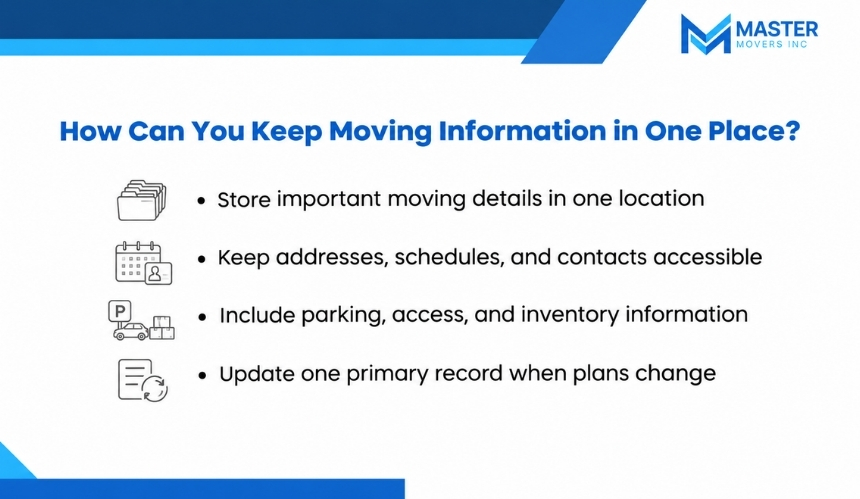
Important moving details should be stored in one location that the main decision-maker can access quickly. When addresses, schedules, access instructions, inventory notes, and moving documents are scattered across messages, emails, and handwritten notes, finding the correct information can become unnecessarily difficult.
A dedicated digital folder, moving document folder, or organized note can serve as the household’s main reference throughout the move.
Which Moving Details Should Everyone Be Able to Find?
The central record should include the pickup and delivery addresses, important contact information, agreed moving details, property access instructions, parking or elevator arrangements, and notes about belongings requiring attention.
Important documents should also remain accessible rather than being packed inside the moving shipment.
Pro tip: Keep one primary version of moving information instead of maintaining several separate lists. When something changes, update the main record so household members are less likely to rely on outdated instructions.
How Should Boxes Be Labeled to Prevent Mix-Ups?
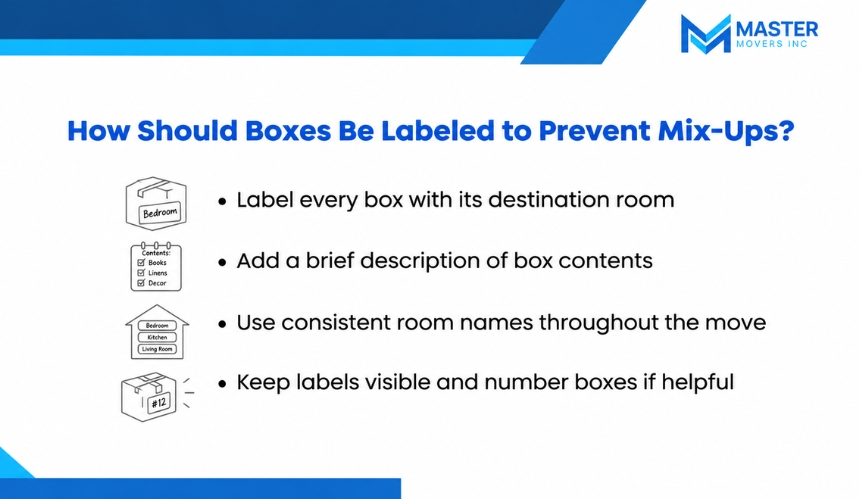
A consistent labeling system helps everyone understand where each box belongs without repeatedly asking for directions. Labels should be easy to read and follow the same format across the entire move rather than changing from room to room.
Each box should identify its destination clearly. Adding a short description of the contents can also make important belongings easier to locate without opening several boxes after arrival.
Should Boxes Be Labeled by Room or Contents?
Using both can provide the clearest identification. The destination room tells movers where the box belongs, while a brief contents description helps the household understand what is inside.
For example, “Kitchen | Pots and Pans” communicates more useful information than a vague label such as “Kitchen Stuff.”
How Can a Simple Labeling System Help at the New Home?
Room names on boxes should match the names used at the destination. If boxes are labeled “Bedroom 2,” everyone should know exactly which room that refers to when unloading begins.
Numbering boxes can provide another reference point, particularly when paired with a simple inventory list.
Pro tip: Place labels where they remain visible when boxes are stacked. A label that appears only on the top can become difficult to read once other boxes are placed above it.
How Can You Keep Personal Essentials From Getting Mixed Into the Move?
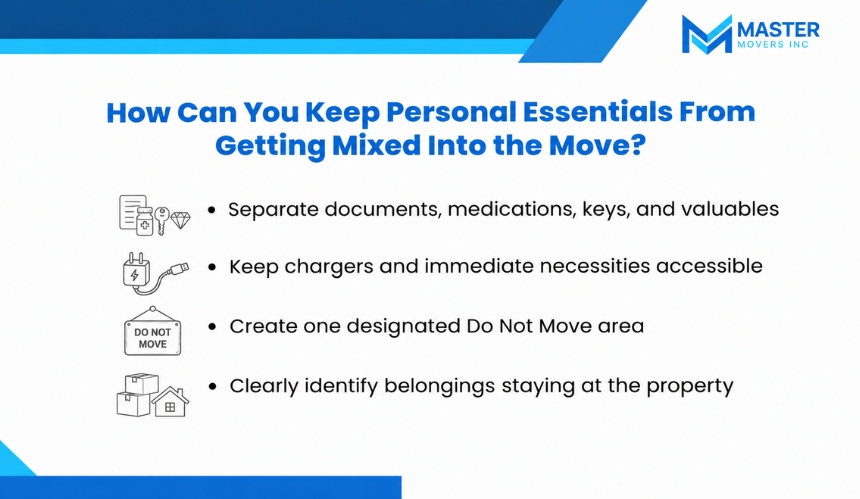
Some belongings need to remain with the household throughout the relocation rather than becoming part of the general moving load. If these items are left beside ordinary boxes, they can be difficult to locate later or may be loaded unintentionally.
Documents, identification, medications, wallets, keys, phones, chargers, valuable personal items, and immediate necessities for children or pets should be separated before moving activity begins.
Where Should Items That Are Not Being Moved Be Kept?
Choose one clearly defined location away from boxes and furniture being loaded. This could be a designated room, a secured area, or the family’s personal vehicle when appropriate. Everyone involved should understand that belongings in this location are not part of the shipment.
Items intentionally staying at the old property should also be separated and clearly identified rather than mixed with packed belongings.
Important insight: Creating one “Do Not Move” area is usually clearer than placing personal essentials in several different rooms. A single boundary reduces uncertainty about which belongings should be loaded and which should remain with the household.
Who Should Make Decisions During the Move?
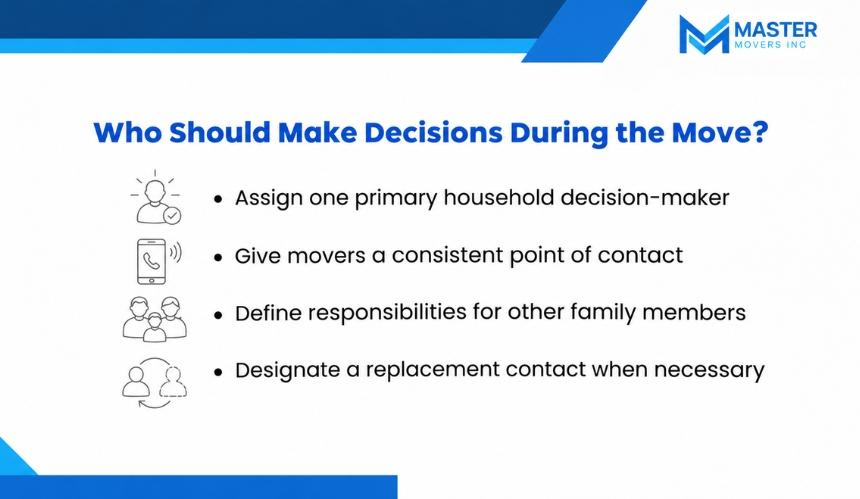
A home move becomes harder to coordinate when several people give different answers about the same belongings. Before moving activity begins, the household should decide who can make immediate decisions about loading, furniture placement, items staying behind, and other move-related questions.
Other family members can still manage their assigned responsibilities, but important instructions should remain consistent rather than changing depending on who is asked.
Why Should Movers Have One Main Point of Contact?
One primary contact gives the moving crew a clear person to approach when a question arises. This is particularly useful when deciding whether an item should be loaded, clarifying a box destination, or confirming where furniture belongs at the new property.
If the primary contact needs to leave, another person should be clearly designated to take over rather than allowing several people to provide separate instructions.
Important insight: Conflicting instructions can create more confusion than a delayed decision. When family members disagree about something during the move, they should resolve it among themselves and then provide one clear answer to the moving crew.
What Instructions Should Be Shared Before Loading Starts?
Important instructions should be communicated before belongings begin leaving the home. Waiting until an item is already being carried or loaded can create uncertainty about whether it belongs in the shipment, requires particular attention, or should remain behind.
The household’s main contact should identify items that are not moving, belongings requiring special attention, unusual access conditions, and any agreed instructions that affect loading. These details should be consistent with the information previously provided to the moving company.
Which Items Should Be Pointed Out to the Movers?
Clearly identify fragile or unusually difficult belongings, large furniture, items staying at the property, and anything that could be confused with the moving shipment. If boxes use special labels or room codes, explain the system before loading begins.
Did You Know?
For interstate moves in the U.S., customers receive an inventory when the mover prepares one for the shipment. Reviewing descriptions and condition information carefully can help identify discrepancies before the move progresses.
Important insight: Special instructions are most useful when they are specific. Instead of repeatedly giving directions throughout loading, explain the important exceptions at the beginning and keep one household contact available for follow-up questions.
How Can You Prevent Items From Going to the Wrong Room?
Confusion can continue at the new home if movers know an item is going upstairs but do not know which bedroom, office, or storage area is intended. Before unloading begins, the household should establish clear destination names that match the labels already placed on boxes and furniture.
Using the same terminology throughout the move reduces repeated questions and makes it easier to direct belongings correctly the first time.
Should Rooms at the New Home Be Labeled Too?
Yes. Simple room signs can be especially helpful when several spaces look similar or when labels such as “Bedroom 1” and “Bedroom 2” are being used. Place the corresponding room name where it can be seen easily from the hallway or entrance.
For example, a box marked “Bedroom 2” should have an obvious destination labeled “Bedroom 2” at the new property rather than relying on different family members to explain which bedroom was intended.
Pro tip: Finalize room names before unloading starts and avoid changing them midway through the process. Matching box labels, room signs, and verbal directions creates one consistent system for everyone involved in the move.
How Can Families Keep Children and Pets From Adding to Moving-Day Confusion?
Children and pets can require attention at the same time household members are answering questions and directing belongings. Families should decide before the move who will supervise them and where they will stay while loading or unloading is underway.
The goal is to prevent family responsibilities from becoming mixed with mover coordination. A designated caregiver or separate supervised area can allow the main household contact to remain available when decisions are needed.
Why Should Child and Pet Responsibilities Be Assigned in Advance?
Without a clear plan, the person coordinating the move may repeatedly have to leave to manage a child or locate a pet. Assigning these responsibilities beforehand keeps roles clear and reduces the number of competing tasks during active moving periods.
Pet carriers, children’s essentials, snacks, medications, and other immediate necessities should also remain separate from the general shipment so family members know exactly where to find them.
Pro tip: Keep the child or pet plan simple and communicate it to everyone involved. When household members know who is responsible for supervision and which areas should remain undisturbed, there is less opportunity for conflicting instructions during the move.
What Should You Do When Moving Plans Change?
Changes can happen during a home move, but confusion often develops when updated information does not reach everyone who needs it. If an item is added or removed, an access arrangement changes, or a different placement decision is made, the household should communicate the update clearly rather than allowing old and new instructions to circulate at the same time.
The main household contact should confirm what has changed and replace the previous instruction with one clear decision.
Who Needs to Know About a Last-Minute Change?
The change should be communicated directly to the person responsible for coordinating that part of the move. Household members affected by the decision should also receive the same updated information so they do not continue giving outdated directions.
For example, if a piece of furniture that was originally going to a bedroom now belongs in the office, the box or furniture label should be updated where practical rather than relying only on a verbal correction.
Important insight: The problem is not always the change itself. Confusion develops when different people continue working from different versions of the plan. One confirmed update should replace the previous instruction for everyone involved.
How Can a Final Walkthrough Prevent Moving Mix-Ups?
Before leaving the old home, one household member should complete a systematic walkthrough to confirm that the loading process matches the moving plan. This provides a final opportunity to catch belongings that were overlooked, items that should not have been loaded, or spaces that were never checked.
The walkthrough should include bedrooms, closets, cabinets, bathrooms, garages, basements, attics, patios, sheds, and other storage areas included in the move.
What Should You Verify Before Leaving the Old Home?
Confirm that belongings intended for the new home have been accounted for and that items meant to stay behind remain at the property. Personal essentials, keys, documents, medications, and other belongings traveling separately should also be checked before departure.
If the household used a box numbering system or inventory list, this is an appropriate point to use it as a reference rather than relying entirely on memory.
Important insight: A final walkthrough is more than a search for forgotten belongings. It acts as a last verification point between the household’s moving plan and what was actually loaded, helping resolve potential mix-ups before everyone leaves the property.
Frequently Asked Questions
How can I stay organized during a home move?
Use one central source for moving information, label boxes consistently, separate personal essentials, and assign clear household responsibilities. One person should also act as the primary contact for movers so instructions remain consistent throughout loading and unloading.
What is the best way to label boxes for moving?
Label each box with its destination room and a short description of its contents. Use the same room names at both properties. Numbering boxes and keeping a simple inventory can provide another reference point when checking or locating belongings.
Who should give movers instructions on moving day?
Ideally, one household member should serve as the main decision-maker and point of contact. Other family members can handle separate responsibilities, but questions about loading, belongings, access, and room placement should receive consistent answers from the designated contact.
How do I keep important items from getting packed or loaded?
Separate identification, medications, documents, keys, valuables, electronics, and immediate necessities before moving activity begins. Keep them in one clearly designated “Do Not Move” area or with the household rather than beside boxes intended for loading.
How can I prevent boxes from going to the wrong rooms?
Use matching labels on boxes and destination rooms. For example, boxes marked “Bedroom 2” should correspond with a clearly identified “Bedroom 2” at the new property. Consistent names reduce the need for repeated verbal directions during unloading.
What should I check before leaving the old home?
Complete a room-by-room walkthrough, including closets, cabinets, garages, attics, basements, and outdoor storage areas. Confirm that intended belongings were loaded, items staying behind remain separate, and personal essentials are still with the household.