

- Finish packing, labeling, furniture disassembly, and decluttering before moving day so the active move is limited to loading, transport, and unloading.
- Confirm the truck, helpers, parking, elevator access, keys, and start time in advance to prevent delays before loading begins.
- Choose a truck that can handle the full shipment in one trip whenever possible, because repeated runs add extra loading, driving, parking, and unloading time.
- Stage belongings near the exit, load in a logical order, and send boxes and furniture directly to their final rooms to reduce unnecessary handling.
- Use professional moving help when heavy items, stairs, tight access windows, or labor limits are likely to become the main bottleneck.
Moving across town should not require an entire day, but delays often come from poor preparation, inefficient loading, limited access, or repeated trips rather than the driving distance itself. A short-distance move becomes faster when packing, staging, transportation, and unloading are planned as one coordinated process.
The goal is to reduce handling time, eliminate avoidable waiting, and keep the move progressing without unnecessary interruptions. This guide explains how to organize an across-town move so it can be completed efficiently without consuming your full day.
Identify What Can Turn a Short Move Into an All-Day Move
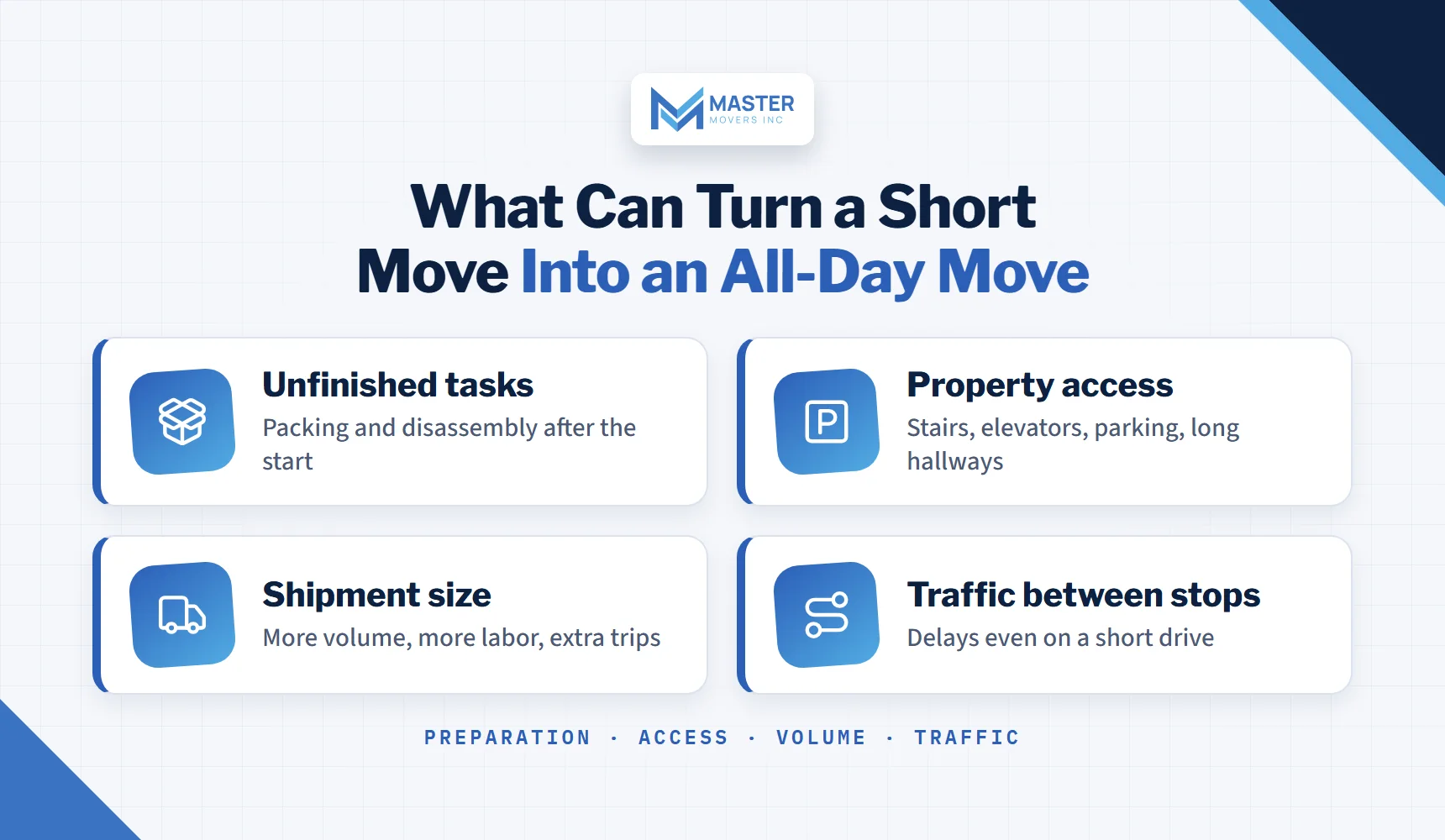
A short travel distance does not automatically make a move fast. Total move time is usually controlled by preparation gaps, property access, shipment volume, and the number of handling steps required before the truck reaches the destination.
Fort Worth uses an Intelligent Transportation Systems network with traffic monitoring and coordinated signal timing to manage real-time congestion across the city. This means even a short-distance move can take longer than expected when traffic conditions add delays between loading and unloading locations.
What Moving-Day Tasks Cause the Biggest Delays?
Packing and furniture disassembly can slow loading when they continue after the move has already started. Movers or helpers cannot maintain a steady loading sequence if boxes are still being sealed, drawers are being emptied, or large furniture must be taken apart room by room.
Loose belongings create the same problem because they require individual handling rather than efficient batch movement. Every unfinished task adds pauses between trips to the truck and reduces the amount of productive loading time available.
How Does Property Access Affect Moving Time?
The distance between the home and the moving truck can matter more than the driving distance across town. Stairs, elevators, long hallways, narrow entrances, gated access, and limited parking increase the time required to move each item from the property to the vehicle.
These delays multiply across the full shipment. A few extra minutes spent handling each group of boxes or pieces of furniture can significantly extend the loading and unloading process when repeated throughout the move.
Can Shipment Size Turn a Local Move Into an All-Day Job?
Shipment volume determines how much must be packed, carried, loaded, secured, transported, and unloaded. A larger household requires more labor and more truck space even when the new address is only a short drive away.
Vehicle capacity also affects the schedule. If the moving truck cannot hold the entire shipment, additional trips introduce repeated loading, driving, parking, and unloading cycles. A nearby destination reduces travel time, but it does not eliminate the operational cost of making multiple runs.
Complete the Time-Consuming Work Before Moving Day
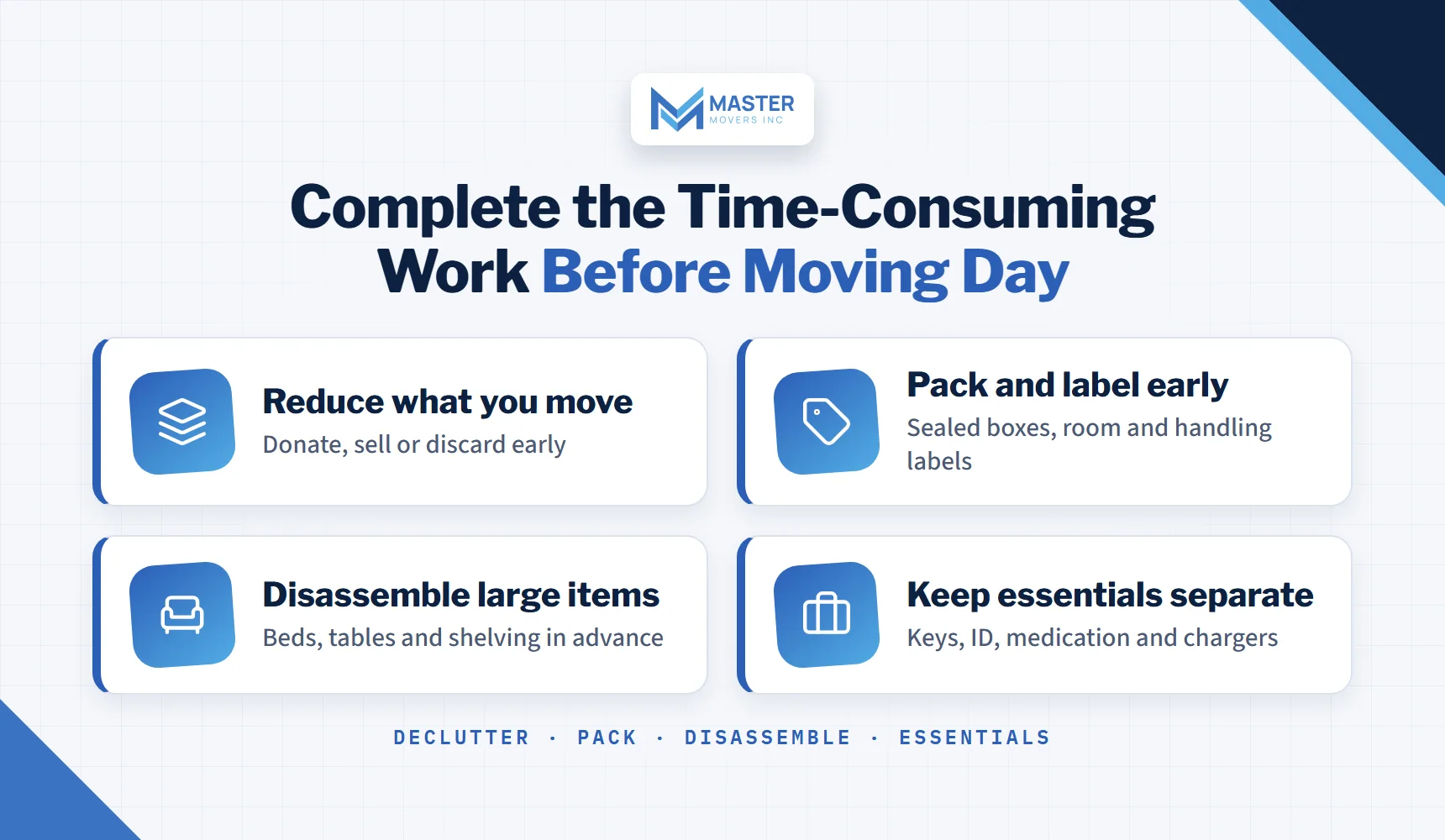
The fastest local moves remove preparation work from the moving-day schedule. Packing, sorting, disassembly, and item organization should be completed in advance so the active move is limited to handling, transport, and placement.
Reduce the Amount You Need to Move
Every item removed before moving day eliminates several later tasks, including packing, carrying, loading, transport, and unpacking. Decluttering is therefore a direct time-reduction strategy rather than a separate organizational exercise.
Focus first on belongings that are unused, duplicated, damaged, or unlikely to be needed in the new home. Donations, disposal, and item sales should be completed early enough that unwanted belongings do not remain in staging areas or consume truck capacity.
Pack and Label Everything Before the Move Starts
Boxes should be fully packed, sealed, and labeled before loading begins. Open containers, loose household items, and partially packed rooms interrupt the movement of goods because each item still requires a handling decision.
Labels should identify the destination room and any handling requirement, such as fragile contents or orientation. Clear labeling reduces questions during unloading and allows boxes to be placed correctly without reopening them or moving them a second time.
Disassemble and Prepare Large Items in Advance
Furniture that cannot pass through doors, hallways, or stairwells in one piece should be disassembled before the moving window begins. Beds, tables, modular shelving, and other large items can consume substantial time when disassembly starts only after helpers or movers arrive.
NIOSH identifies bulky loads, awkward postures, twisting, and carrying as physical risk factors during manual handling. Breaking large furniture into smaller, more manageable components can therefore reduce awkward handling during the move.
Hardware should be bagged, labeled, and attached securely to the corresponding item where practical. Cables, removable shelves, drawers, and detachable components should also be secured so large items are ready for immediate handling.
Keep Moving-Day Essentials Out of the Main Shipment
Items needed during transit or immediately after arrival should travel separately from the primary load. Packing them inside the main shipment can force unnecessary searching before the truck is fully unloaded.
Keep keys, identification, medication, chargers, basic tools, important documents, water, cleaning supplies, and other immediate-use belongings in a clearly designated essentials bag or container. This preserves access to critical items without disrupting the moving sequence.
Create a Moving-Day Plan That Minimizes Waiting and Extra Trips
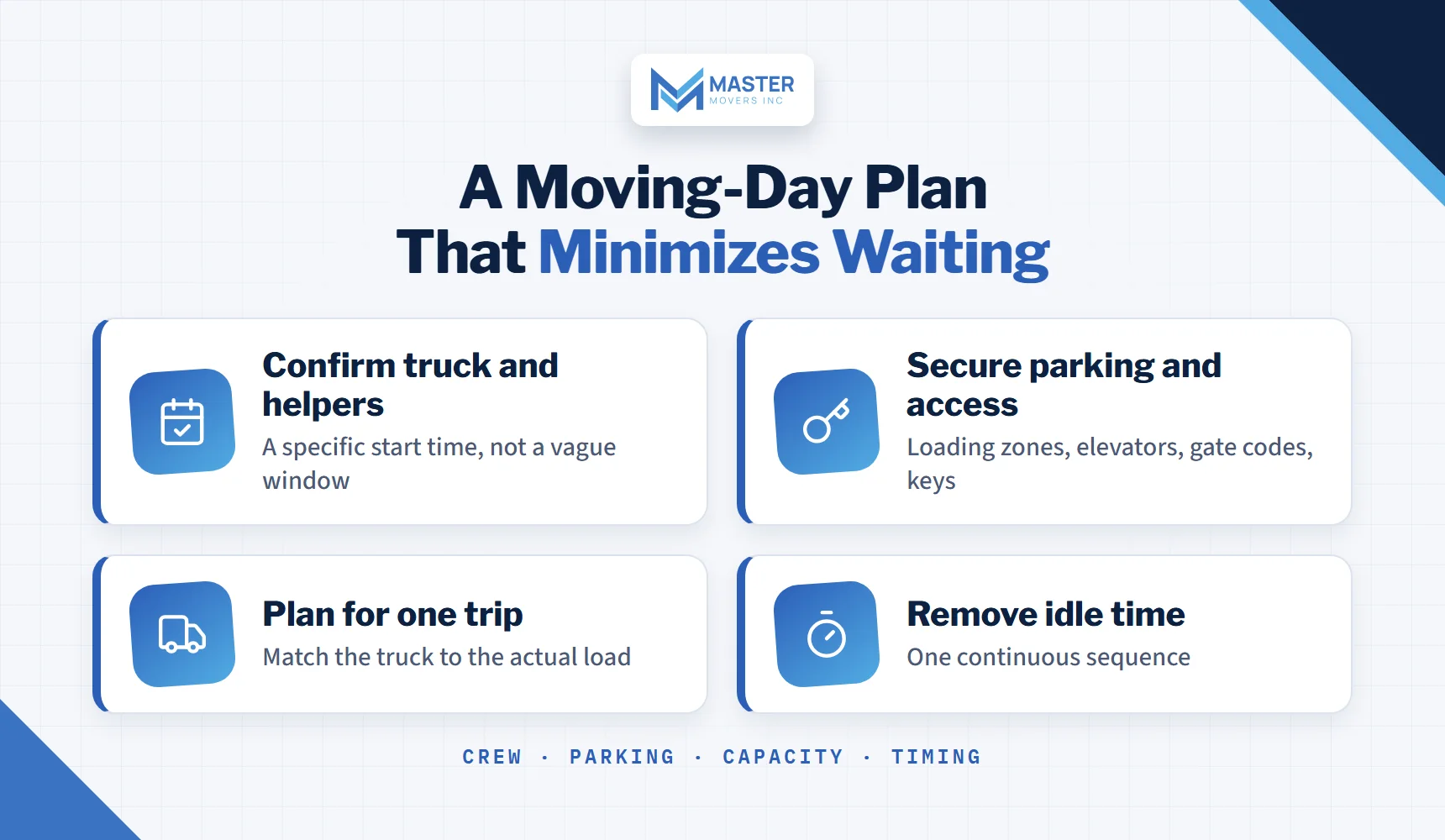
A local move stays efficient when labor, vehicle access, property entry, and transportation are synchronized before loading begins. The objective is to remove idle time between stages so the move operates as one continuous sequence.
Confirm the Truck, Helpers, and Start Time
Set a specific start time and confirm that the moving truck, drivers, movers, or helpers will be available when the property is ready for loading. A vague arrival window can create downtime if people, equipment, or access become available at different times.
The schedule should also account for truck pickup, crew arrival, building access, and any fixed deadlines later in the day. Aligning these dependencies prevents one delayed resource from pushing the entire move behind schedule.
Secure Parking and Property Access Before Loading Begins
Parking and entry arrangements should be resolved at both addresses before moving day. Confirm driveway availability, loading-zone rules, elevator reservations, gate codes, keys, and any building-specific move requirements that could restrict access.
The truck should be positioned as close to the loading and unloading points as legally and safely possible. Reducing unnecessary carrying distance shortens each transfer cycle and keeps labor focused on moving belongings rather than navigating access problems.
Plan for One Trip Whenever Practical
A single transport cycle is usually the most efficient option for an across-town move because it avoids repeating truck loading, travel, parking, and unloading procedures. Estimate the shipment size against usable vehicle capacity before selecting the truck.
Bulky furniture, irregularly shaped items, and poorly stacked boxes can reduce practical cargo space even when the truck appears large enough by volume. Matching the vehicle to the actual load lowers the risk of leaving items behind and having to repeat part of the move.
Load and Unload in an Order That Saves Time
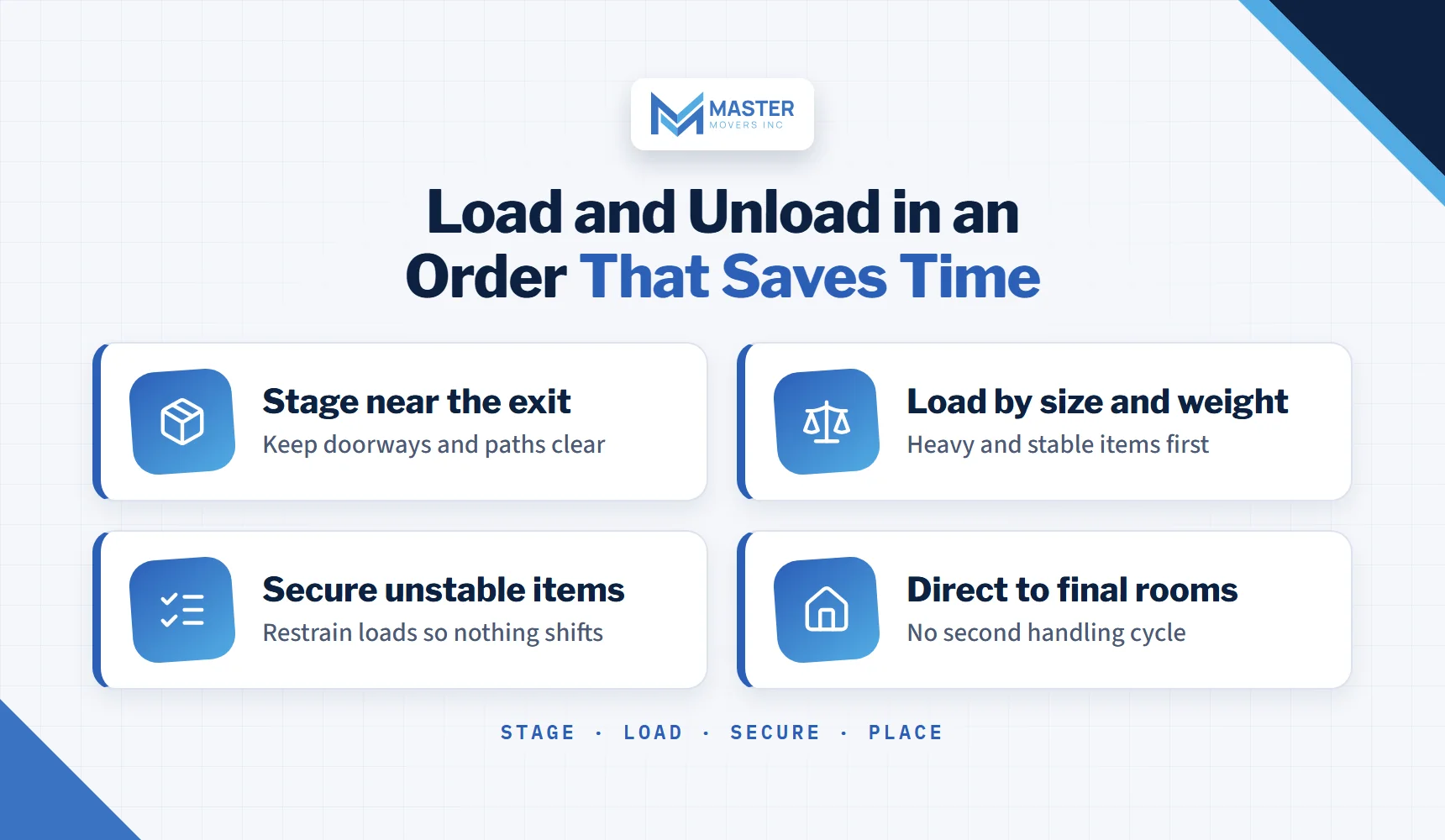
Efficient handling depends on controlling the order in which belongings move through the property, truck, and destination. A clear loading sequence reduces congestion, protects fragile items, and prevents unnecessary repositioning during unloading.
Stage Belongings Near the Exit Before Loading
Prepared items should be grouped in accessible staging areas before the truck is loaded. Boxes, smaller furniture, and other ready-to-move belongings can be positioned near the main exit as long as doorways, stairs, and walking paths remain clear.
Staging reduces the distance helpers travel inside the property and prevents repeated room-to-room searching. It also creates a predictable flow from the home to the truck, which makes it easier to maintain a consistent loading pace.
Load by Size, Weight, and Unloading Priority
Heavy and stable items should generally be positioned first so they can form a secure base inside the truck. Lighter boxes and fragile belongings can then be placed where they are less likely to shift, compress, or sustain damage during transit.
FMCSA cargo-securement standards require commercial loads to be restrained so items cannot shift or fall during transportation. Although household moves have different regulatory circumstances, the same safety principle supports securing heavy furniture and unstable items rather than relying on tight stacking alone.
Unloading priority should also influence placement. Items needed immediately at the destination should remain reasonably accessible, while pieces that belong deeper inside the new property can be positioned to support an efficient unloading sequence.
Direct Items to Their Final Rooms During Unloading
Boxes and furniture should move directly from the truck to their intended rooms instead of being placed in a temporary pile near the entrance. Room labels and predetermined furniture locations allow helpers to make placement decisions without stopping to ask where each item belongs.
Direct placement eliminates a second handling cycle after the truck is empty. It also keeps entryways and common areas clear, reducing congestion as unloading continues.
Follow a Simple Same-Day Sequence to Keep the Move on Schedule
A same-day move is easier to control when each phase has a clear handoff to the next. The sequence should limit backtracking, prevent last-minute decisions, and keep attention on completing the move rather than starting nonessential setup tasks.
Moves often lose time during transitions between stages rather than during the actual drive. Treating loading, departure, unloading, and essential setup as separate phases helps prevent task-switching, backtracking, and avoidable pauses that can stretch a same-day move into a much longer process.
What Should Be Checked Before Loading Starts?
Before the first item leaves the property, complete a final operational check. Confirm that access points are open, walking paths are clear, utilities or building requirements are resolved, and essential belongings are separated from the main shipment.
Use this stage to identify anything that could interrupt departure, such as forgotten rooms, unsecured outdoor items, missing keys, or belongings that were not included in the moving plan. Resolving these issues before loading starts is faster than discovering them after the truck is packed.
Keep the Move Continuous During Loading and Transportation
Once loading begins, avoid activities that interrupt the established workflow. Repacking boxes, searching for personal items, rearranging belongings unnecessarily, or stopping for nonessential tasks can break the pace of the move.
After the truck is loaded and the property is checked, proceed directly to the destination. Keeping the transition between loading and transport short preserves the time gained through earlier preparation.
Focus on Placement During Unloading, Not Full Setup
The priority after arrival is to empty the truck efficiently and place belongings where they can remain. Furniture can be positioned in its intended location, but detailed organization, decorating, and nonessential assembly should wait until the transportation phase is complete.
This separation prevents setup decisions from competing with unloading activity. It also ensures the truck, helpers, and available access window are used for the tasks that cannot be postponed.
What Should Be Done Once the Truck Is Empty?
After unloading, perform a quick inventory check to confirm that the shipment has been transferred and inspect the truck for small or overlooked items. Then restore only the functions needed for the first part of the day or evening, such as assembling a bed, connecting essential appliances, or accessing toiletries and chargers.
Full unpacking should begin only after the active move is finished. Treating transportation and household setup as separate phases keeps a short local relocation from becoming an unnecessary all-day project.
Ready to move across town without losing your whole day? Master Movers Inc provides reliable local moving, apartment moving, furniture moving, packing, piano moving, office moving, and long-distance moving services throughout the Dallas-Fort Worth area. Get professional help where it matters most and keep your move efficient from pickup to final placement.
Frequently Asked Questions
How far in advance should I book movers for a short move across town?
For a short local move, booking two to four weeks ahead usually provides better crew and time-slot availability. Busy summer periods, weekends, and month-end dates can require more lead time. If your date is fixed, reserve earlier and confirm the cancellation, rescheduling, and arrival-window terms before paying a deposit.
Do local movers charge a minimum even if my move only takes an hour or two?
Many local moving companies use a two-, three-, or four-hour minimum because dispatching a truck and crew creates fixed operating costs. A move that finishes below that threshold may still be billed at the minimum. Compare quotes by asking whether travel time, fuel, equipment, and minimum labor hours are included.
Is hourly or flat-rate pricing better for a short local move?
Hourly pricing can work well for a small, straightforward move when the scope is predictable, while a flat rate provides more cost certainty when the job has variables. Compare the same service scope and ask what can trigger extra charges. The lowest headline rate is not necessarily the lowest final moving cost.
What protection do I have if movers damage something during a local move?
Coverage depends on the mover, contract, and jurisdiction. For U.S. interstate moves, federal rules distinguish Full Value Protection from Released Value, while in-state moves may follow different state requirements. Before loading, ask for the liability terms in writing, declare high-value items where required, and document valuable belongings with photos and receipts.
Should utilities stay active at both homes on moving day?
Keeping electricity and water available at both properties during the moving window can prevent practical problems with lighting, cleaning, elevators, climate control, and appliance checks. Exact account-transfer rules vary by provider and lease terms. Schedule activation at the new home before arrival and avoid shutting off the old service prematurely.
What items can a moving company refuse to put on the truck?
Professional movers may refuse hazardous or restricted materials such as gasoline, propane cylinders, paint thinner, fireworks, corrosive chemicals, and certain batteries. Restrictions can vary by carrier and jurisdiction, so request the mover’s non-allowables list before packing. Dispose of or legally transport restricted items separately rather than hiding them inside household boxes.
What happens if I cannot get the keys to the new place when the movers arrive?
A delayed key handover can create paid waiting time, rescheduling charges, or temporary storage needs, depending on the mover’s contract. If possession timing is uncertain, ask in advance how waiting is billed and whether the crew can hold the shipment. Keep the mover updated before the truck leaves the original property.
- Identify What Can Turn a Short Move Into an All-Day Move
- Complete the Time-Consuming Work Before Moving Day
- Create a Moving-Day Plan That Minimizes Waiting and Extra Trips
- Load and Unload in an Order That Saves Time
- Follow a Simple Same-Day Sequence to Keep the Move on Schedule
- Frequently Asked Questions