
- Master Movers Inc
Moving Day Timeline for Busy Families
Quick Overview: A practical moving day timeline should divide the day into clear stages so packing leftovers, family needs, mover coordination, travel, and unloading do not compete for attention at the same time. Exact hours vary by move, but the sequence should remain organized. A typical timeline includes:
Important insight: A useful moving day timeline is based on milestones rather than rigid clock times. Loading or travel may take longer than expected, but families can still stay organized when everyone knows what needs to happen before the next stage begins. Pro tip: Choose one adult as the main contact for the moving crew. This prevents conflicting instructions while allowing other family members to focus on children, pets, personal belongings, and last-minute household needs. |
Moving day can become especially demanding for busy families because several responsibilities need attention at once. Movers may need directions, children and pets need supervision, essential belongings must remain accessible, and both the old and new homes require final coordination. Without a clear sequence, small delays can quickly disrupt the rest of the day.
A moving day timeline gives each stage a defined purpose without requiring every task to happen at an exact minute. Families can focus first on final checks, then mover arrival and loading, followed by departure, unloading, and immediate setup. Organizing the day around these milestones helps reduce conflicting tasks and keeps family responsibilities manageable throughout the relocation.
Before the Movers Arrive
The first stage of the moving day timeline should focus on getting the family ready before loading begins. This is not the time for major packing or household projects. Instead, families should complete only the final tasks needed to leave the home and keep the rest of the day organized.
Ideally, everyone should be dressed and ready, personal essentials should be separated from the shipment, and one adult should be prepared to meet the moving crew.
Complete the Final Household Check
Before the scheduled arrival, make a quick room-by-room check for unfinished tasks. Confirm that boxes intended for the move are ready, belongings staying behind are clearly separated, and keys or access information are available.
This early check prevents small unfinished tasks from competing for attention once loading starts.
Get Children, Pets, and Essentials Ready
Children and pets should have a clear plan before movers begin carrying belongings through the home. Families may arrange supervision away from active loading areas or designate a secure space that does not interfere with the moving route.
Keep medications, identification, important documents, phones, chargers, snacks, water, keys, and immediate child or pet necessities with the family rather than inside the moving shipment.
Pro tip: Set a personal deadline about 30 to 60 minutes before the movers are expected. Use that final window only for family readiness and last checks rather than starting new packing tasks.
When the Moving Crew Arrives
When the moving crew arrives, the family should shift from preparation to coordination. Before loading begins, the main household contact should meet with the crew and confirm the basic plan for the day. This helps address questions early instead of interrupting the move after belongings are already being carried out.
The initial discussion should cover the areas being moved, property access, belongings staying behind, and any items that require particular attention.
Review the Day Before Loading Starts
Take a few minutes to walk through the home with the crew or crew lead. Point out large or difficult items, boxes that need appropriate handling, areas that should not be loaded, and any access conditions that could affect the carrying route.
Families should also confirm how questions will be handled during loading so one person remains the primary point of contact.
Did You Know?
For interstate U.S. moves, federal consumer guidance advises customers to be present when their shipment is loaded and to carefully review moving documents before signing them.
Important insight: This part of the timeline should be brief but deliberate. Resolving questions at the beginning can reduce repeated interruptions once loading is underway.
During the First Hour of Loading
Once loading begins, busy families should avoid treating the first hour as extra time for unfinished moving tasks. The main priority is to let the crew establish a steady loading process while keeping one adult available for questions or decisions.
Other family members can focus on supervising children or pets, keeping personal essentials together, and making sure belongings marked to stay behind remain separate from the shipment.
Stay Available Without Blocking the Loading Process
The main family contact should remain easy to reach but avoid standing in doorways, hallways, or other active carrying routes. If the crew has a question about a particular item, room, or access point, having one designated decision-maker can prevent conflicting instructions.
This is also a useful time to watch for rooms becoming empty and identify anything that may have been overlooked without repeatedly interrupting the crew.
Did You Know?
Moving-day schedules can be affected by more than the number of boxes. Stairs, carrying distance, property access, bulky furniture, and the amount of household goods can all influence how quickly loading progresses.
Important insight: Busy families should treat the first hour as the point when the moving-day rhythm is established. Once loading is progressing smoothly, household attention can shift toward the remaining family responsibilities and preparation for departure.
While Loading Is Underway
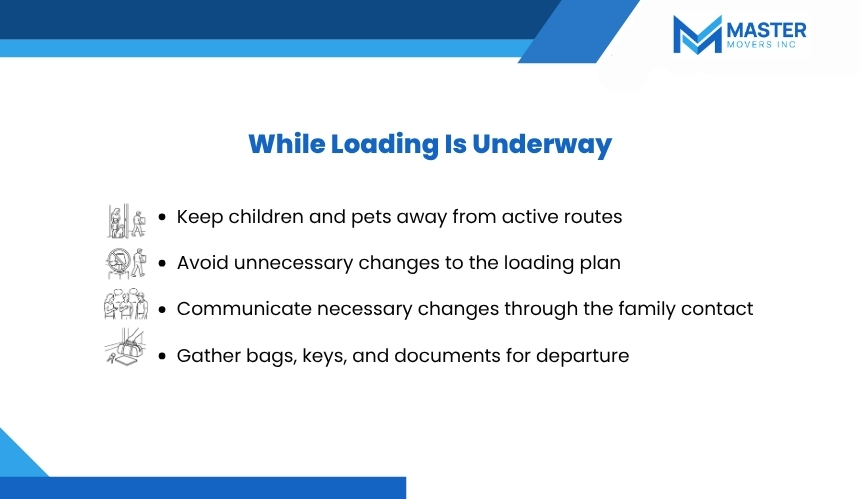
As loading continues, the family’s role should shift toward maintaining organization rather than supervising every box. One adult should remain available for questions, while the rest of the household focuses on children, pets, personal belongings, and preparations for leaving the property.
This stage can take a significant portion of moving day, so families should avoid introducing unnecessary changes that interrupt an established loading process.
Keep Children and Pets Away From Active Routes
Doorways may remain open and movers may repeatedly travel between rooms and the truck while carrying items that limit their visibility. Children and pets should therefore remain away from hallways, stairs, entrances, and other active carrying areas.
Having supervision arranged before loading begins allows parents to manage this part of the timeline without repeatedly stopping other moving-day tasks.
Avoid Making Unnecessary Last-Minute Changes
Once loading is underway, changing which belongings are moving, adding unprepared items, or giving different instructions can disrupt the established plan. Necessary changes should be communicated directly through the designated family contact.
Pro tip: Use quieter periods during loading to prepare for the departure stage. Gather personal bags, confirm keys and documents are accounted for, and be ready for the final walkthrough once the last belongings are loaded.
What Should Families Check Before the Moving Truck Leaves?
Before leaving the old home, families should complete a final walkthrough after most or all belongings have been loaded. This stage belongs in the timeline before departure because returning for forgotten items can disrupt travel plans and delay arrival at the new property.
The walkthrough should be systematic rather than rushed, with one adult checking each area while the rest of the family prepares to leave.
Which Areas Should Be Checked for Forgotten Items?
Check closets, cabinets, drawers, bathrooms, bedrooms, utility areas, garages, basements, attics, patios, and other storage spaces. Families should also look behind doors and in areas where small belongings may have been temporarily placed during loading.
What Should Stay With the Family Instead of the Movers?
Before the truck departs, confirm that identification, medications, important documents, keys, phones, chargers, wallets, travel necessities, and immediate supplies for children or pets are still with the family.
Important insight: The final walkthrough should happen before the household leaves the property, not after everyone has already started traveling. It creates a clear checkpoint between the loading and travel stages of the moving day timeline.
What Should Families Do During Travel to the New Home?
Once the moving truck has left, the family should shift attention to reaching the new property and being ready for the unloading stage. Important belongings should remain accessible during travel rather than being packed somewhere inside the moving shipment.
Families should carry keys, identification, moving documents, medications, phones, chargers, water, snacks, and immediate supplies for children or pets. Keeping these necessities together reduces the need to search through boxes immediately after arrival.
Who Should Arrive at the New Home Before Unloading Begins?
Whenever possible, an adult who can make decisions should be available at the new property when the moving crew arrives. That person can provide access, answer questions, and direct belongings to the appropriate rooms.
For busy families, responsibilities can be divided so one adult handles mover coordination while another focuses on children, pets, or other immediate family needs.
Pro tip: Keep the new-home keys and access information with the person responsible for meeting the movers. Packing them in luggage carried by another family member can create an unnecessary delay at the next stage of the timeline.
What Should Families Do Before Unloading Begins?
Before boxes and furniture start entering the new home, families should make sure the property is ready to receive them. The person coordinating the move should unlock the required entrances, confirm the unloading route is clear, and be available to tell the crew where major belongings should go.
Taking a few minutes to organize this stage can prevent boxes from accumulating in the wrong rooms and reduce the need to reposition heavy furniture later.
How Should Rooms Be Assigned Before Boxes Come In?
Family members should decide where major furniture and labeled boxes belong before unloading starts. If room names are unclear, simple directions such as “upstairs front bedroom,” “main bedroom,” or “office” can help connect box labels with the correct spaces.
The person directing the crew should remain near an appropriate decision point rather than moving between rooms whenever a question arises.
What Should Be Cleared Before the Movers Start Unloading?
Check the entrance, stairs, hallways, and routes leading to the main rooms. Personal bags, children’s belongings, pet supplies, and other items brought separately should not block these paths.
Important insight: The few minutes before unloading begins are an important transition in the moving day timeline. Clear room assignments at this stage can save families from sorting misplaced boxes and repositioning furniture after the crew leaves.
What Should Families Do While Movers Are Unloading?
During unloading, families should focus on directing belongings efficiently rather than beginning to unpack immediately. One adult should remain available to answer placement questions while other family members manage children, pets, personal essentials, or immediate household needs.
Clear directions at this stage can reduce misplaced boxes and prevent large furniture from being moved multiple times.
Which Furniture Should Be Positioned First?
Large furniture should be directed to its intended room and approximate position while the moving crew is available to handle it. Beds, sofas, dining furniture, desks, and other bulky pieces can be difficult for a family to reposition after unloading is complete.
Room placement decisions should therefore be made before these items enter the home whenever possible.
Where Should Essential Boxes Be Placed?
Boxes containing first-night necessities should remain easy to identify rather than becoming buried among the rest of the shipment. Families may designate one accessible area for toiletries, bedding, children’s necessities, medications, chargers, basic kitchen items, and other immediate needs.
Pro tip: Avoid unpacking ordinary boxes while unloading is still underway. Keeping pathways open and concentrating on correct placement can make the unloading stage more organized and leave unpacking for after the moving activity has finished.
What Should Families Prioritize During the First Hour After Unloading?
Once unloading is complete, busy families do not need to start unpacking the entire home immediately. The first hour should focus on making the new space functional enough for the family’s immediate needs after a demanding moving day.
Start with necessities that affect the evening and following morning. Locate medications, toiletries, chargers, clothing, children’s supplies, pet essentials, and basic food or drink items that were intentionally kept accessible.
Which Rooms Should Be Set Up First?
Bedrooms and bathrooms usually deserve early attention because families will need somewhere to sleep, change, and complete basic routines. Beds and bedding can be prepared before attention shifts to decorative items or nonessential boxes.
For families with young children, setting up a familiar sleeping area and locating their immediate necessities can also reduce the amount of searching required later in the evening.
What Can Wait Until the Next Day?
Decorating, organizing storage, arranging books, unpacking seasonal belongings, and perfecting furniture placement can usually wait. Trying to complete everything on moving day can make an already full timeline unnecessarily demanding.
Pro tip: Define a clear stopping point for moving day. Once everyone has a place to sleep and essential household needs are accessible, the remaining unpacking can become part of the following day’s schedule.
What Is a Practical Moving Day Timeline for Busy Families?
A moving day timeline should provide structure without assuming every relocation will follow the same exact hours. Home size, number of belongings, travel distance, property access, and loading requirements can all affect how long individual stages take. For busy families, milestones are often more useful than a rigid minute-by-minute schedule.
Moving Stage | Main Family Priority |
30–60 minutes before arrival | Complete final checks and get the family ready |
Movers arrive | Review the plan and identify special items |
Loading begins | Keep one adult available for questions |
During loading | Manage children, pets, essentials, and departure needs |
Before truck departure | Complete the final walkthrough |
Travel period | Keep necessities accessible and coordinate arrival |
Before unloading | Open the property and confirm room assignments |
During unloading | Direct furniture and boxes to the correct rooms |
First hour afterward | Set up sleeping areas and immediate necessities |
Should Families Follow Exact Moving Day Times?
Not necessarily. The actual duration of loading, transportation, and unloading can vary considerably between moves. Families should therefore use the timeline as a sequence of checkpoints and adjust the clock as the move progresses.
Important insight: A delayed stage does not have to disrupt the entire day. When families know what must happen before loading, departure, unloading, and first-night setup, they can adjust their timing while keeping the overall moving plan organized.
How Can Busy Families Keep the Moving Day Timeline From Falling Behind?
A moving day schedule can lose momentum when unresolved tasks appear after loading has already started. For busy families, the most effective approach is to identify decisions and responsibilities early so attention is not repeatedly pulled away from the current stage of the move.
Common schedule disruptions include unfinished packing, missing keys or access information, unexpected belongings, unavailable decision-makers, unclear furniture placement, and last-minute changes to what is being moved.
Which Moving Day Delays Can Families Prevent?
Families can reduce avoidable delays by making sure one adult remains available for decisions, personal essentials stay separate, property access is confirmed, and major changes are communicated as early as possible.
Tasks that do not affect the immediate move, such as detailed unpacking or organizing the new home, can wait until loading and unloading are complete.
Did You Know?
Access conditions can influence how efficiently belongings move between a home and the truck. Stairs, elevators, long carrying routes, restricted loading areas, and difficult entrances may add time even when the household itself is fully prepared.
Important insight: Building flexibility into the timeline is more practical than scheduling every stage to the minute. Families should protect the sequence of the day and leave enough room for loading, travel, or unloading to take longer than expected.
Frequently Asked Questions
What time should a family be ready on moving day?
Families should be fully ready before the movers’ scheduled arrival. Allowing about 30 to 60 minutes beforehand for final checks, personal essentials, children, pets, and access arrangements can help prevent unfinished household tasks from delaying the start.
What should families do while movers are loading?
One adult should remain available for questions and decisions while other family members manage children, pets, and personal belongings. Families can also prepare for departure and check emptied areas without blocking active carrying routes or interrupting the loading process unnecessarily.
How long does a typical moving day take?
There is no single timeline that applies to every move. Household size, number of belongings, property access, travel distance, stairs, elevators, and other moving conditions can affect loading and unloading time. Families should plan around stages rather than assuming a fixed duration.
What should parents keep with them during moving day?
Parents should keep identification, medications, keys, phones, chargers, important documents, water, snacks, and immediate necessities for children or pets accessible. These belongings should remain separate from the shipment so they are available throughout travel and arrival.
What should families do before the moving truck leaves?
Complete a room-by-room walkthrough and check closets, cabinets, drawers, garages, storage spaces, and outdoor areas. Families should also confirm that personal essentials and belongings intended to travel separately have not accidentally been loaded.
What should families do first after movers finish unloading?
Focus on immediate household needs rather than unpacking everything. Prepare sleeping areas, locate medications and toiletries, connect necessary chargers, and organize essential supplies for children or pets. Less urgent unpacking and household organization can continue the following day.